
Making the web more accessible: A Win for AI and everyone

TL;DR: This article explores how enhancing web accessibility benefits users with disabilities, improves the performance of AI agents, computer vision systems, and overall user experience (UX), and creates a win-win situation for users and AI agents. By aligning with WCAG standards and the European Web Accessibility Act, web developers can create inclusive, efficient, and future-proof digital environments.
We are in the AI age of web development; with the coming of AI agents and AI operators, the current iteration of AI agents relies heavily on computer vision. OpenAI (just) released their version of “Operator”, Sonnet has “Computer use” and there are other open source alternatives like Open computer use. If we want to take full advantage of AI operators, we should design the web to make it easier for AI agents. Not only do we increase the output quality for AI agents, but another user group benefits from more accessible websites: Users with disabilities. Making the web more accessible creates a win-win scenario for developers, users with special needs, and AI alike.
Why is creating an accessible web essential?
According to the World Health Organization (WHO), approximately 15% of the global population -- over one billion people -- live with some form of disability. In certain regions, such as the United States, studies have shown that nearly 1 in 4 adults report having a disability.
In Europe, alongside these statistics, the recent implementation of the European Web Accessibility Act has set precise legal requirements for public sector websites and mobile applications, reinforcing the need for accessible digital services across the continent.
I suffer from red-green color blindness (Deuteranomaly) and struggle with websites with insufficient contrast.

Different Types of Disabilities and Their Web Impact
- Visual Impairments: This includes blindness, low vision, and color blindness. Color blindness is one of the most common disabilities, affecting around 1 in 12 men and 1 in 200 women worldwide. Websites should ensure sufficient contrast and straightforward typography and avoid relying solely on color to convey meaning.
- Hearing Impairments: Users with partial or complete hearing loss benefit from captions, transcripts, and visual indicators.
- Motor Disabilities: Conditions that limit movement, such as cerebral palsy or arthritis, make using a mouse or keyboard difficult. Websites should be fully navigable via keyboard and offer alternative input methods.
- Cognitive Disabilities: Dyslexia, ADHD, and other cognitive impairments require clear layouts, simple navigation, and readable fonts to avoid overwhelming users.
If you want to try out how the different disabilities, someone created a fun game (In Dutch) that you can try here: [Accessibility Game]
The framework
Luckily, you don’t have to reinvent the wheel: the Web Content Accessibility Guidelines (WCAG) provide a framework for making digital content accessible to all users. Initially developed by the World Wide Web Consortium (W3C), WCAG 2.0 (and its subsequent updates) outlines recommendations for making web content perceivable, operable, understandable, and robust. Following these guidelines ensures that websites are navigable and usable for people with various disabilities, from visual impairments to motor difficulties.
Applying the WCAG not only makes websites more navigable for users with disabilities but should also increase them for regular users and AI operators.
Why would I spend my budget improving the tools for only 15% of my user base? Sometimes, it is not merely a technical requirement; it has real-world implications. For example, filing an official tax return in the Netherlands is exclusively conducted online. If web content is inaccessible, individuals with disabilities face significant barriers to completing essential civic duties, making it harder to participate fully in society.
Best Practices for Developers and UXers
Accessibility should be considered from the very beginning of the design process. Research how user groups interact with digital content and ensure accessibility is integrated into wireframing, design, and development. The earlier accessibility is factored in, the less costly and time-consuming it will be to fix issues later.
Additionally, remember that AI agents may consume your website’s content. Structuring your data properly, using semantic HTML, and ensuring machine-readable metadata can help AI-driven tools interpret your website more effectively.
For web developers looking to harness these dual benefits, consider these actionable strategies:
- Embrace Semantic HTML: Use correct semantic elements to ensure screen readers and AI operators can effectively parse the content. Read more here
- Implement ARIA Landmarks: Accessible Rich Internet Applications (ARIA) roles can improve navigation for assistive technologies and help AI systems locate and interpret content. Read more here
- Optimize Image and Media Content: Always include descriptive alt text and transcripts, which aid users and train computer vision algorithms to recognize images more accurately.
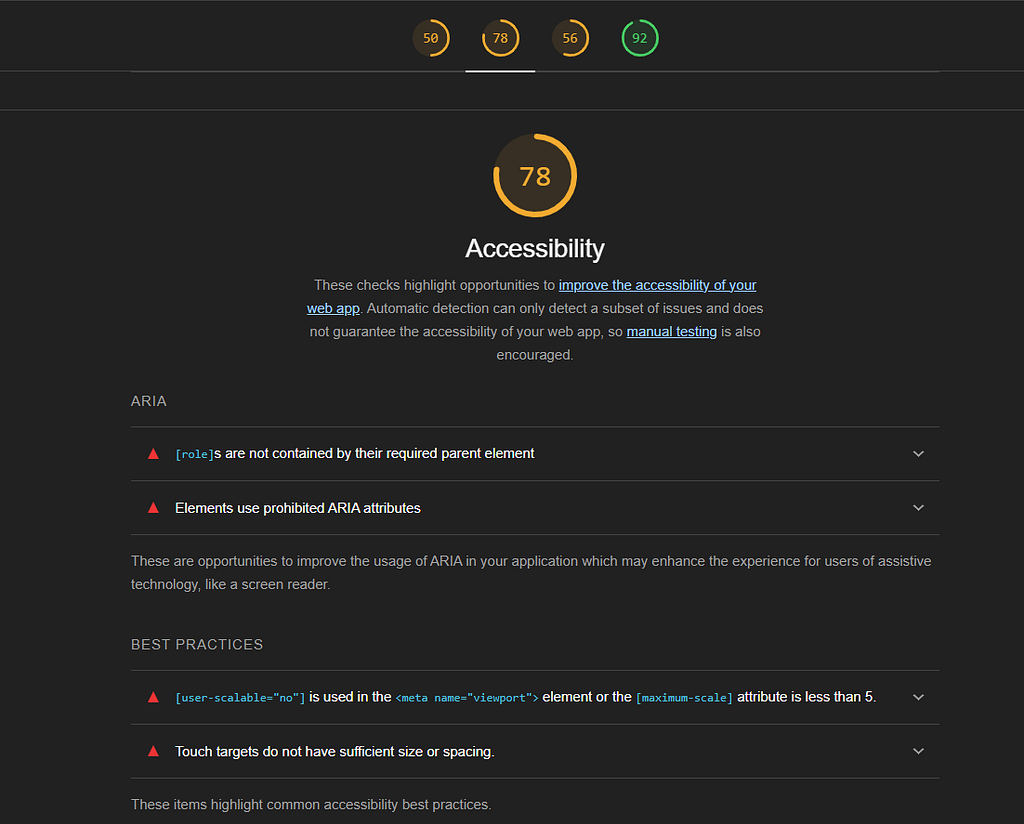
- Test Regularly: Assess accessibility using both human testers and AI-driven tools. Test websites using different setups, such as navigating with keyboards or trying to navigate your website using audio only. Tools like Chrome Lighthouse and WAVE can help identify issues impacting AI interpretation. Integrate them within your CI/CD.
- Ensure Sufficient Contrast: Many users have some form of color blindness or low vision. Using tools like the WebAIM contrast checker to ensure proper text-background contrast improves readability for a broad audience. Also, do not rely solely on color; icons and text can help users identify the correct element.
- Be aware of the Guidelines: Both WCAG and AI technologies are evolving. Staying informed, engaging with communities, and subscribing to updates from reliable sources like the W3C and European regulatory bodies are essential. To make it official, you should do an independent audit.
Conclusion
By prioritizing accessibility, web developers can create digital experiences that are both inclusive and technologically advanced. Regulations like the European Web Accessibility Act, alongside robust WCAG standards, reinforce the foundations laid by accessible web design, ensuring that emerging technologies--such as AI operators and computer vision systems--perform at their best. Ultimately, this creates a win-win scenario: Human users benefit from more inclusive designs, and AI systems become more capable and reliable, pushing the boundaries of what’s possible on the web.
Sources