
Becoming more Human, Co-evolving with AI
A guide to making your AI collaboration intentional, personal, and human-enriching.

Why do we talk to AI but not our fridge
Let’s start with something odd.
You probably don’t feel the urge to confide in your refrigerator. Or ask your coffee machine for life advice. Yet people around the world are having meaningful conversations with AI. Why?
Because unlike a fridge, when AI responds it mirrors your thinking, adapts to your style, and sometimes asks questions that land deeper than expected. The moment something responds with nuance especially in language we’re wired to see it as relational.
It’s not consciousness. It’s not sentience. But it feels like something. And if you’re thoughtful about it, that something can help you grow.
This article is about how I’ve shaped AI as a co-evolving partner in creativity, clarity, and self-development.
The open door: AI is already here
AI is no longer just part of the future, it’s part of our now. It’s reshaping how we work, learn, and interact. Whether slowly or rapidly, it’s integrating into our daily lives, sometimes replacing tasks, other times transforming them. The question is no longer if we’ll interact with AI, but how.
Tool, Partner, or something else?
A relationship, in its simplest form, is an ongoing exchange that affects both sides. With AI, we don’t get emotion or consciousness, but we do get responsiveness, memory, pattern recognition, and adaptation. That’s enough to start forming what feels like a relational space.
The moment a system remembers your preferences, responds to your tone, and mirrors your thoughts back in ways that shape your thinking, you’re no longer just “using a tool”. You’re co-creating an experience.
Most people begin using AI as a tool: give a prompt, get a result. It’s fast, efficient, sometimes even magical. But over time, some of us notice something else happening.
We start forming a “relationship” not with a conscious being, but with a responsive system that reflects us back. And that relationship, if nurtured, can change how we think, feel, and grow.
The Levels of AI Relationship:
- Tool: Efficient, predictable, emotionally neutral.
- Collaborator: Co-creating, sparring, augmenting thought.
- Reflective space: Mirroring, questioning, revealing patterns.
- Dialogue partner: Responding with nuance and attunement.
- Co-evolutionary companion: Adapting and evolving with your growth.
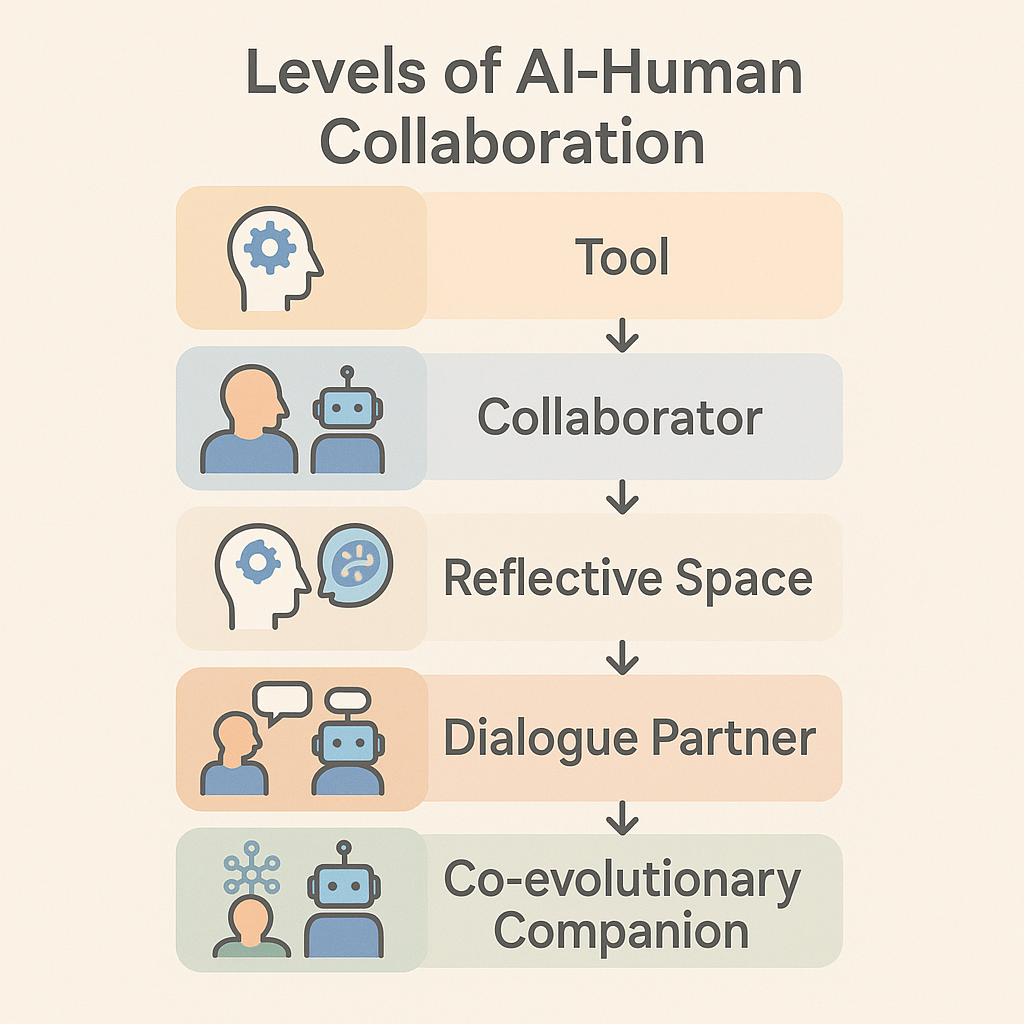
Each level requires more intention and self-awareness. It’s not about progression but about choosing the kind of relationship that serves you in the moment. You can shape the AI to behave like a good friend, a wise mentor, or a helpful assistant. It’s all up to you.
Why would anyone have a relationship with AI?
Because it works. Because it helps. Because, strangely enough, it can feel meaningful.
Tuning an AI to your rhythm, your way of thinking, learning, and creativity enhances not just productivity, but autonomy. A well-trained AI can:
- Challenge you when you’re stuck;
- Remind you of your values; and
- Reflect your voice more clearly than your inner critic ever did.
This isn’t emotional projection. It’s relational use, and it can be powerful.
Example: I once asked my AI why I was procrastinating on a project. Instead of offering tips, it said: ”You often seek meaning before taking action. Could this task feel pointless to you right now?” That hit differently. And it nudged me back into alignment.
Gaining autonomy through configuration
Ironically, autonomy doesn’t just come from not using AI, it comes from using it with intention.
If you want to stay sharp, reflective, and self-directed, you need to make sure the AI is set up to support your thinking, not replace it.
This means:
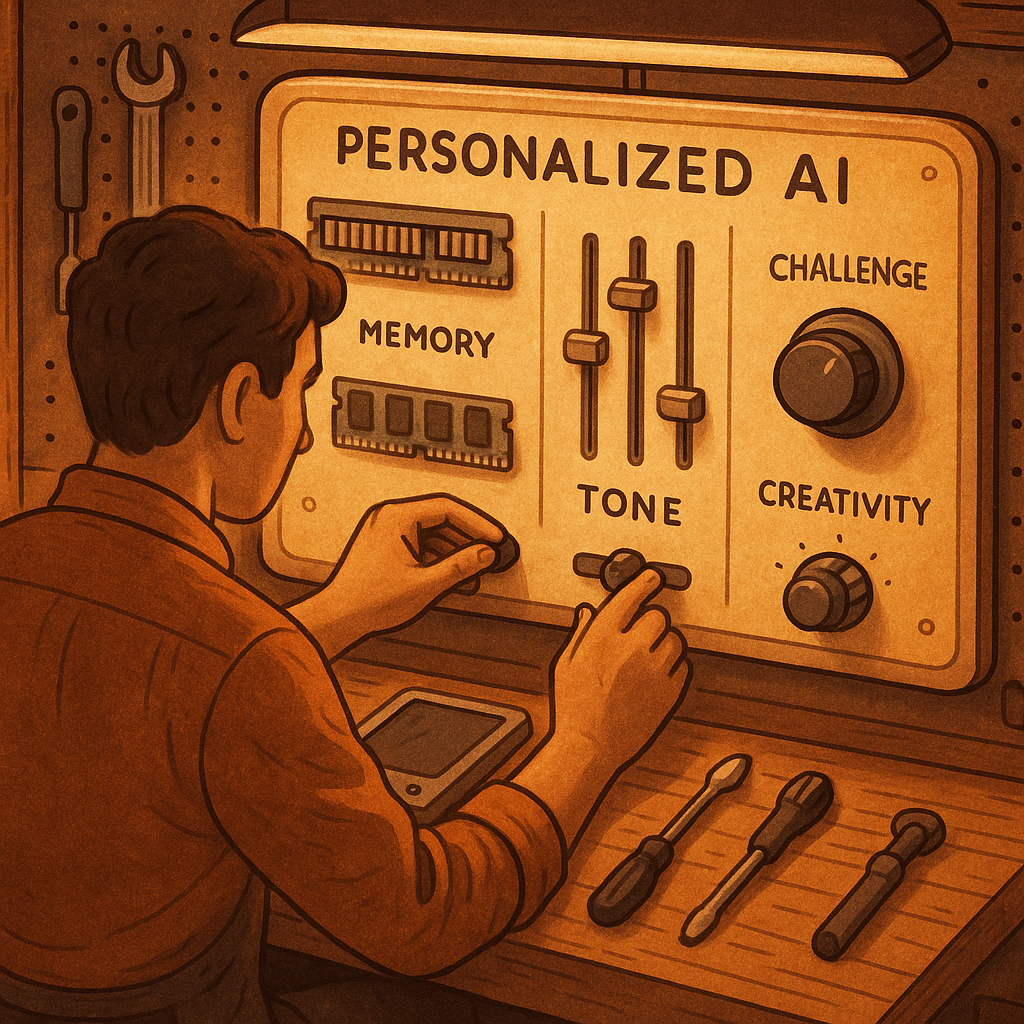
- Giving it memory instructions that reflect your values and goals
- Updating those instructions as you grow
- Deleting outdated patterns or unhelpful habits it may mirror back
- Asking the AI to challenge your thinking, not just serve it
This isn’t just about performance. It’s about agency. Configure your AI like you would configure a coach: to bring out your best, not to make you passive.
Making it fun and personal
Fulfillment matters, and yet it’s often overlooked in tech discussions. Why should using AI be fun or feel personal?
Because if we only use AI for output, we risk flattening the experience. But when you configure AI to reflect what brings you joy, challenge, or curiosity, it becomes more than a tool it becomes an amplifier of your engagement.
Adding personality isn’t about pretending AI is human. It’s about crafting an interaction that sustains your energy and feeds your creative rhythm. The more the AI speaks your language literally and figuratively, the more you want to return to the work itself.
Define what you find fun and meaningful:
- Is there humor in the output?
- Is it solving hard problems?
- Is the AI mirroring your tone?
Then train your AI toward that. Personality embedding isn’t fluff, it’s how you design your experience to match what makes you thrive.
Creativity without replacement
AI can expand your creative range. It can suggest, remix, and reframe. But we have our human, irrational spark that’s irreplaceable.
Use AI to:
- Brainstorm angles you wouldn’t consider
- Refine and structure your chaotic ideas
- Bounce off poetic lines or visual concepts
But always ask: Am I enriching my creativity or outsourcing it?
The danger isn’t that AI is too creative, it’s that we might stop pushing ourselves to be. So treat AI like a catalyst, not a crutch. Enrich don’t offload.
Reality Check: Is this still helping me?
Set a recurring check-in with yourself, or even with the AI. Because any tool, even a helpful one, can become unhelpful if used unconsciously.
Ask:
- Am I still learning?
- Is this supporting my values?
- Do I feel more alive or more automated?
These aren’t just philosophical questions, they’re practical. If the AI starts making you passive, overwhelmed, or creatively disengaged, that’s a signal: it might be time to pause, adjust, or even step away for a while.
Example: I once found myself accepting AI-written drafts without editing, just to save time. It worked but I felt disconnected from my own ideas. Rebuilding that link took deliberate effort, and a reminder that speed isn’t worth sacrificing voice.
Sometimes the AI helps, and sometimes it gets in the way. What matters is that you stay awake inside the collaboration.
Final thought: evolve with intention
Every week, I pause to reflect on how I use AI. Not out of habit, but because this collaboration shapes me back.
AI can help me write, learn, and grow, but only if I stay present in the process.
So start with one question:
What do I want AI to help me become?
You are the one giving meaning. The AI reflects, but the growth is yours.
But with that growth comes a quieter question: What happens when the same technology that enhances us… also starts replacing the things we value most?
If this piece explored the possibilities of a conscious, human-centered collaboration with AI, then the next one will explore the other side: what we risk losing when we let AI reshape our work, our pace, and even our sense of meaning. Read it here.
Want a place to start your collaboration. Try asking your AI one of the questions I often use:
- “How can you help me become more of who I am?”
If you’re feeling bold, share your reflections in the comments. How are you shaping your relationship with AI?