

“You’re not good enough.”, “You will fail.”
These are the words my inner critic whispers every time I step outside my comfort zone. For years, I believed them. Until I realized -- I didn’t have to.
In my previous blog, My Journey with Perfectionism, I explored how becoming aware of and reflecting on our deeply ingrained beliefs is the first step toward breaking free from self-sabotaging limitations. Perfectionism for me stemmed from a desire to exist and for others to accept me, making it challenging to embrace imperfection and growth.
As I continued my journey, I realized that these limiting beliefs were not just abstract thoughts but were actively reinforced by a persistent inner voice -- the inner critic. This voice manifests as self-doubt, harsh self-judgment, and fear, keeping me trapped in cycles of anxiety and hesitation. Understanding this inner critic became crucial in my process of self-growth.
Recognizing the Inner Critic
My inner critic did not arise out of nowhere. Past experiences, fears, and societal expectations shaped it. It fed my perfectionism, making me believe that success was the only way to feel worthy.
As I delved deeper into my work experiences, I realized that my struggles were not just about meeting expectations--they were tied to a voice within me. This voice emerged more often in moments of challenge or social situations, reinforcing self-doubt and hesitation.
Beneath my perfectionist tendencies, I could hear thoughts like:
- “You are worthless.”
- “You can’t do this.”
- “You will fail.”
- “You are not good enough.”
The first step for me was becoming aware of these thoughts. Once I became aware, I initially tried reasoning with them (which failed), then ignoring them (which also failed), and finally countering them with positive thinking (which had some success). This realization led me to explore the origins of my inner critic and how it shaped my perception of myself.
However, the challenge was recognizing that this voice was not reality--it was merely a distorted perspective holding me back. While it had served a purpose in my youth, it became a barrier to my growth as an adult.
Seeking Professional Support
A word of advice: If your inner critic is overwhelming or significantly affecting your well-being, consider seeking support from a coach or therapist. They can help you develop strategies to manage self-doubt and build confidence healthily. There is only so much you can do alone if you are stuck. Also, I only got here by using lots of coaching and meditation.
Personal Story: Facing My Inner Critic
In 2019, I was preparing to teach my first lessons as a Zen teacher. As always, taking a new step was scary for me. Whenever I try something new, I don’t know what to expect, which makes me anxious. Despite all my preparation, my anxiety increased as the moment approached. My stomach twisted, my pulse pounded in my ears, and a heavy fog of self-doubt settled over me. ‘Who would want to listen to me?’ the voice whispered, relentless:
- “What do I have to offer?”
- “What if I fail?”
- “What if I make mistakes?”
- “You haven’t prepared enough.”
- “You are not worthy.”
As the moment drew closer, these thoughts became more frequent. Not only did I experience these thoughts, but I also had physical symptoms of stomach pain and a headache. The first ten minutes of my lesson felt unbearable, as I kept thinking, “They must see that I’m nervous.” Sitting on my meditation cushion while looking at my eight students, I felt their eyes burning holes in me, expecting me to perform. These ten minutes felt like hours. I usually start with a small meditation and am able to connect with this feeling of anxiety, So simply staying present with what I am feeling in my body, I allowed those sensations to settle and become calmer. Eventually, I found my flow and finished the session. And none of my students knew any of what I felt.
Afterward, I felt victorious for facing my inner critic head-on. I had shown myself that everything was okay--even if I was nervous, made mistakes, or hadn’t prepared perfectly. With each subsequent lesson, these anxious feelings diminished. Yet, whenever I face something new or challenging, my inner critic still resurfaces, attempting to “protect” me from failure.
Navigating the Comfort, Learning, and Pain Zones
My story illustrates how the inner critic often appears when we step outside our comfort zones. It tries to keep us safe by warning us of failure, embarrassment, or rejection. But I’ve learned that these warnings aren’t a sign of stopping--they’re simply part of the process.
Many personal growth theories mention three zones:
- The Comfort Zone -- The space where everything is familiar and safe. No risk, no failure -- but also no real growth.
- The Learning Zone -- Where we stretch ourselves, face challenges, and develop new skills. It’s uncomfortable but necessary.
- The Pain Zone -- A place of overwhelm, where challenges feel too big, often leading to avoidance or burnout.
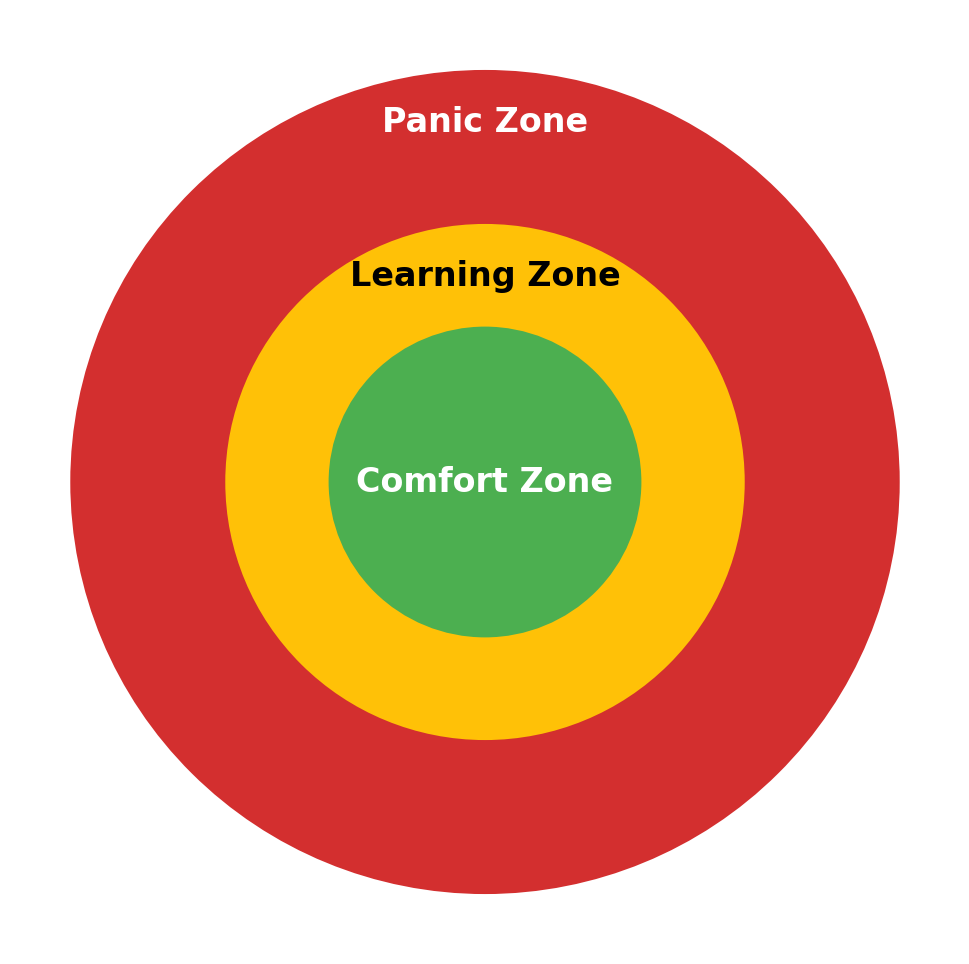
I stayed in my comfort zone for a long time, letting my inner critic convince me that stepping out meant disaster. But avoiding discomfort didn’t make me feel safer -- it kept me stuck. Over time, I realized that growth doesn’t happen without discomfort.
When I was preparing to teach my first Zen lesson, my inner critic was relentless. My stomach ached, and my thoughts raced. Who am I to do this? What if I fail? At that moment, I felt like I had stepped too far. But instead of retreating, I allowed myself to sit with that discomfort. Slowly, I settled into the moment, found my flow, and finished the lesson.
With each step into the learning zone, my comfort zone expands. And even when I accidentally push too far into the pain zone, I know now that it’s not failure -- it’s just a signal to pause, regroup, and try again.
The Story of Two Wolves

An old Cherokee Indian chief was teaching his grandson about life.
He said, “A fight is going on inside me,” he told the young boy, “a fight between two wolves.
The Dark one is evil -- he is anger, envy, sorrow, regret, greed, arrogance, self-pity, guilt, resentment, inferiority, lies, false pride, superiority, and ego.” He continued, “The Light Wolf is good -- he is joy, peace, love, hope, serenity, humility, kindness, benevolence, empathy, generosity, truth, compassion, and faith. The same fight is going on inside you grandson…and inside of every other person on the face of this earth.”
The grandson ponders this for a moment and then asked, “Grandfather, which wolf will win?”
The old Cherokee smiled and simply said, “The one you feed”.
Our inner critic grows stronger the more we feed it. Recognizing this allows us to choose which “wolf” we nurture intentionally.
Feeding the Wolf of Self-Doubt
My inner critic speaks and creates worst-case scenarios about everything that could go wrong. The dilemma is:
- If I ignore the voice and fail, it feels like my critic was right, making it stronger.
- If I listen to it entirely, I become paralyzed by fear.
What helps is acknowledging my inner critic with respect. Instead of suppressing or blindly following it, I can say:
”I understand your concerns but genuinely want to do this regardless of the outcome.”
Each time I take on a challenge and succeed, I gain more freedom in my choices.
The Inner Coach: A Positive Countervoice
Besides the inner critic, I discovered through coaching that I could develop a more positive voice: the inner coach. This voice says:
- “You’ve done difficult things before -- you can do this too.”
- “Mistakes don’t define you; they help you grow.”
- “You are learning, and that’s enough.”
- “Even if things don’t go perfectly, you’ll be okay.”
- “You are worthy, even when you’re struggling.”
- “Take a deep breath. One step at a time.”
Exercise: Listening to Your Inner Dialogue
Want to understand better and manage your inner critic and manifest your inner coach?
For instance, if you’re about to lead a meeting, your inner critic might say, ‘You’ll mess up in front of everyone.’ A potential inner coach reply could be, ‘You’ve prepared thoroughly and have valuable insights to share.’
Try this exercise:
1. Imagine a situation where you experience self-criticism.
2. Write down what your inner critic says.
3. Ask yourself: Where does this voice come from? What is it trying to do?
4. Write a response from your inner coach -- imagine a good friend, partner, or mentor speaking to you.
5. Read both voices and reflect: Which helps you move forward?
6. Action step: Give your inner coach the lead next time your inner critic speaks up.
Final Thoughts: Finding a healthy balance
The goal is not to silence your inner critic but to find a healthy balance. By recognizing its patterns, challenging its messages, and strengthening the voice of your inner coach, you can shift from self-sabotage to self-support.
As a perfectionist, I always find it hard to find a healthy balance. I often walk the line between completely letting go and trying to be in complete control. In my next post, I’ll explore what helped me find a healthy balance.
Which voice will you choose to feed today? Try the exercise above and see what happens when you give your inner coach the lead.